- Benmore Brief
- Posts
- Insights from our 100+ software development projects. The state of software development, AI, and consulting going into 2026.
Insights from our 100+ software development projects. The state of software development, AI, and consulting going into 2026.
Reviewing data and experiences from our last year's worth of engagements, we lay out our opinion for the transforming landscape of software development and where we see it heading.
The Big Mover: AI and Agentic Coding Tools.
Disclosures:
This article used AI to grammar check. Other than that - this article was manually written.
The opinions outlined in this article are just that, opinions, derived from our experience working on over 100 software development engagements in the past year and being an AI-native consulting firm.
We are an AI-native software development consulting firm, it is in our best interest for AI and AI coding tools to be extremely performant.
Late last year, AI-coding tools like Cursor, Github Co-Pilot, and Devin were introduced into software development - and many developers started talking about AI-driven development. Then, in February, Claude Code was launched - and many developers' worlds broke. The impact of these tools in software development was pretty much explosive - and the term was coined "vibe-coding".
To many developers, coding went from a generally mentally taxing and meticulous process to basically gambling on if the AI tool of choice will generate the correct output or not.
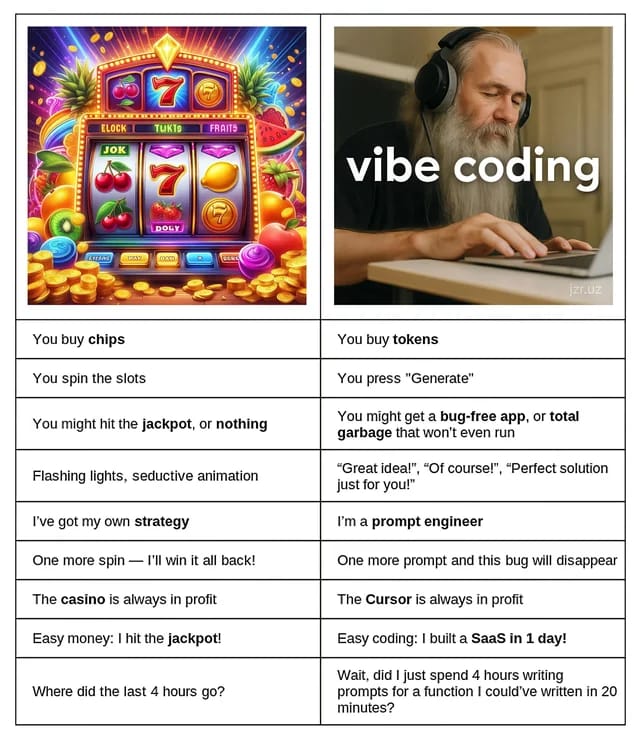
However, the impact was undeniable, and companies across the world pushed their development teams to utilize these tools. Code was getting written at an unprecedented rate - features flying off of the shelves, rapidly built UIs, entire codebases getting rewritten in a matter of days. Amazing… right?
Essentially yes - at least in our opinion - with many caveats.
AI Coding Observations
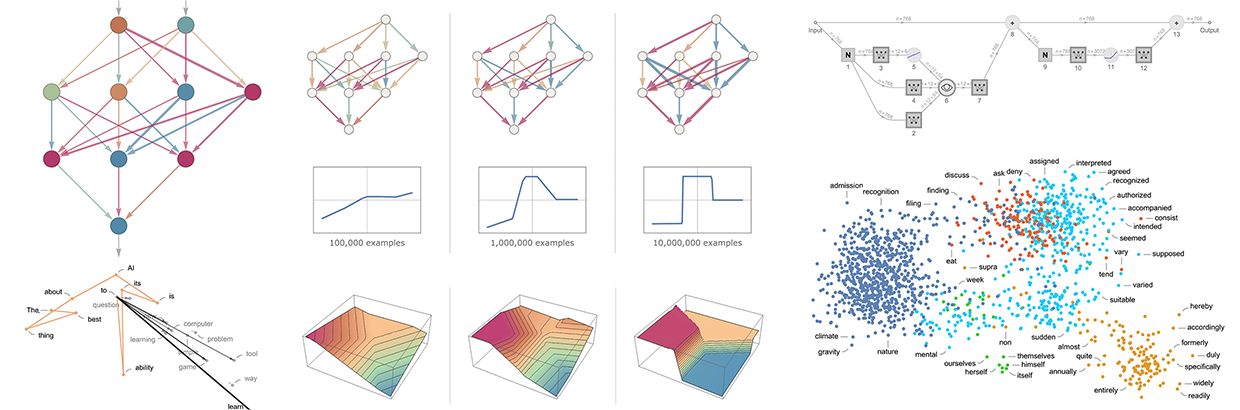
First and foremost, AI (specifically LLMs) are prediction machines. This means that fundamentally, what they spit out - a novel, code, research, etc. - is variable and, to some extent, a game of optimizing chance. Additionally, due to their variable and unpredictable nature, layers of auditing and quality control become increasingly more important.
Article on how ChatGPT works if you’re interested in understanding the math behind these tools:
Context management (what information the AI Agent is given or can refer back to) has also emerged as an incredibly important factor in using these tools. Unfortunately, you can’t feed a 20 million line code base into an AI tool and it just understands everything. When determining what information to give these agents, being intentional and selective in the context is extremely important.
Knowing when to stop the agent is also important. For example, you have 10-20% of your session usage left, it’s probably not a good idea to start work on another massive feature, but instead, to start a new session and feed the AI tool a new set of information and context to orient itself more effectively.
The specific coding language that is being used, in our opinion, is still important, but is losing importance rapidly. However, the guardrails that are being set in said language are increasing in importance. Specifically, understanding that these AI tools are essentially rogue geniuses, you want to let them loose, but giving them access to a helicopter is probably not a good idea.
So, coding languages with many out-of-the-box security features and great design library integrations (prebuilt UI/design code - rather than coding design from the ground up) are more important - because they have more guardrails (and less variability in output). The same goes for your deployment infrastructure: safer, less variable deployment stacks hedge on less customizability but faster, less variable deployment.
We specifically use Django on our backends, and Next.js or React Native for our frontends because of the above reasons. Associated articles below:


Lastly, the coding agents are noticeably better on greenfield projects (projects starting from nothing) rather then picking up work on existing code bases.
Orchestrator Talent and Planning
The above observations in relation to coding are all downstream from two key components that we are seeing skyrocket in importance → orchestrator talent (the competency, skill, knowledge, of the person using the AI agent), and project planning and documentation.
These AI coding tools are emerging as great direction-takers, but they are just going to do whatever you ask. If you ask for a nearly impossible feature, as of right now, there’s little to no push back from the AI agent - it’s just going to try to do it.
If you aren’t meticulous in planning your project out or knowing when something is not feasible, you’ll get stuck in the infamous gas-light loop of the AI agents. Forever being told that a feature is done (Great! I’ve completed <impossible feature> you can now view it from this link!) when it’s just not - because it wasn’t possible in the first place.
So, properly planning out a project and having someone who is knowledgable leading your project is now more important then ever.
The analogy that we like to use is imagine that you could build a physical real-world house by prompting ChatGPT. Yea, your house will be built quickly, but is it compliant with zoning laws? Is it safe? Do you have 30 extra rooms that you don’t need but now need to pump AC and electricity into? Is the balcony facing the right direction? etc.
The difference is as follows →
You prompting ChatGPT to build a house
> Build me a house that is red, looks like the Home Alone house, can store my 3 cars, and will last 1000 yearsA builder prompting ChatGPT (We have no experience in construction, some of the terminology and processes may be incorrect):
> We have a construction project at parcel #XXXXXX, here are the applicable zoning laws and HOA specs <specs>.

Here is the list of materials that we have sourced and their pricing <list> here are our vendors and vendor schedules <vendors>.

Here is the budget for the project <budget>. Note that in about 3 months we're expecting a heavy winter so construction will have to accommodate for below-freezing temps.

Let's start with laying the foundation of the house. Please use the Home Alone house's blueprint (viewable here <homealone_blueprint.pdf>) as a reference for what the foundation of the home should be - and follow it as closely as possible given the guidelines of the project.

Note that the garage foundation in the given blueprint will need to be modified to accommodate a three car garage, in order to stay in spec, please expand the square footage of the home by 15% in order to make room for the additional space - while maintaining the original dimensions of the home.

Once I approve the foundation, we'll move into the framing of the home.
The point is that, at the current moment, these coding tools seem to be most effective by allowing existing experts to leverage their knowledge and implementation efforts. Knowing what to build and how to build it are quickly establishing themselves as the most important aspects of software development.

Benmore company-wide Claude Code analytics for November 2025.
Where we think it’s headed
We think that the implementation of software will continue to hurtle toward net zero labor input. Software can, in the next decade or so, essentially become a commodity. Need a home security app that works with your ring cameras? Call up your local software development provider. Need an app that makes the drivers of your trucking company log their time and integrates with your custom accounting software to track labor expenses? Call up your local software development provider.
We’re already seeing this emerge with many of our clients. Why pay $100 per user per month for a pre-built SaaS that solves 50% of your problem when you could build a software that you own, don’t have to pay extra for as you hire more people, and uniquely completely solves your problem?
It’s coined as the “build or buy” choice and we expect this discussion to start to lean towards building more and more in the coming years. Anecdotally, a team member of ours has mentioned that in China, many companies have chosen to build over buy, even before AI, because of the lower cost of hiring software developers. If this is true, then the model of building over buying has been proven to work outside of the US and would indicate that a similar movement would take place here in the US as AI has made the cost of developing software less expensive.
In the startup ecosystem, a similar phenomenon may take place. A good amount of VC investment has been predicated around the cost to hire a team - now we are seeing a lot of VC money going to fund distribution and marketing. That being said, accessibility to private capital and business loans has exploded recently, potentially allowing founders to hold onto more equity in the earlier stages of growing a startup.
Investors now expect faster revenue growth earlier. They expect leaner teams... Series B has become a cliff. Companies that show rapid revenue expansion and clear distribution scale raise very large rounds. Others stall.
How Benmore is positioned going into 2026
Our company has focused on a couple areas:
Talent acquisition, proprietary tools for our talent to leverage, and engineering-first new-age consulting structure.
Talent
With regard to talent, we noticed that there is massive opportunity when it comes to hiring new grads. Many incumbent software companies have significantly reduced new-grad position openings or closed them completely. It's extremely interesting that in an era when technology valuations are booming, software jobs are diminishing.
However, our view is that new-grads are the most positioned to adopt and become experts in the new era of software development. If AI is as revolutionary as we think, you could make the argument that everyone is starting at an even playing field - or that the original playing field has been flattened significantly. Who better to rapidly adopt, up skill, and become experts in AI-driven development then new-grads?
This is our position and we have made a concentrated effort to attract and retain the most talented new-grads that we can find. Our forward-deployed developers hail from or have experience working at the top computer science universities, Harvard, University of Illinois, Northwestern, and Boston University. Additionally, a key skill that we look for in our hiring process is the usage of AI-coding tools and learning ability.
Proprietary Technology
When it comes to our proprietary technology, taking our earlier claim that AI is a tool to be leveraged, we have built out an internal suite of tools specifically to aid our team. These tools are built to optimize usage of existing tools. For example, we have a deliverable of type “dynamic asset” in our tool suite. It’s a snippet of custom code that is, well, dynamic. It can be a presentation, a design guide, a meeting recap, a roadmap, a spreadsheet etc. Functionally, this allows us to avoid locking into Powerpoint or Excel etc. and instead we can quickly create tailored deliverables at an unprecedented speed.
Another example is our context bank. Throughout the project, all documentation, roadmaps, meetings, etc. are agnostically fed into the coding agents that we utilize. This allows us to consolidate project knowledge into a centralized place that anyone on our team can refer to and AI tools can natively pull from.
We continue to contribute to our internal technology daily, however, the ethos of the initiative is to build things that our team can leverage, not replace them.
Modern Consulting Structure
Lastly, we took a look at the traditional consulting structure that has been solidified over the past couple of decades and, drawing inspiration from new consulting players in the space, essentially flipped the playbook.
Traditional consulting is billed on hours and team members. You would have giants like Accenture staffing 10+ people to a project. Included would be a project manager/lead, two designers, six developers, and a dev ops engineer. Each logging hours, each getting billed for.
However, this never made that much sense to us… aren’t the incentives fundamentally misaligned? It’s in the consulting company’s best interest to assign as many people as possible to a project for as long as possible… right?
Now, with AI, this model is even more backwards. If you have one extremely talented developer who knows how to leverage AI, they could realistically do the work of five people, retain all of the project knowledge themselves rather than having to explain it to an entire team, and concurrently work on two or three other projects while long running AI tasks are being executed (orchestrating AI). So… how do you even bill for an hour of their time?
This is actually a hot topic in consulting at the moment as the entire consulting pricing model is being flipped backwards. We currently are iterating on our pricing model, however, we do know that we should, at the very least, bill on outcomes - this aligns incentives (payment is tied to project completion, so it’s in everyone’s best interest to finish the project.)
Relating back to that AI-enabled developer that we were talking about earlier, that’s incorporated into our process as well. They’re called Forward Deployed Developers and are trained to be proficient in project management, client-facing communication, and, of course, software development. Weaponized with AI, you can flatten project team hierarchies. This results in less communication bottlenecks, more project ownership, and faster implementation… all boiling down to a best-in-class service being delivered faster and at better prices.
Final Thoughts
We’ll end this with a quick anecdote. A couple of weeks ago we got a chance to meet a former director of a large incumbent consulting company and we asked them one quick question: “Did you ever provide your services to SMBs or startups?”. They chuckled a bit and said “hell no”. They didn’t go much into why… but the prevailing rationale is that SMBs and startups can’t afford a three year long, five million dollar project. They can’t light money on fire with unclear deliverables or direction, and they can’t afford to engage in risky incentives because their boss told them too. They need actual value from an engagement. This is the problem that Benmore solves, democratizing consulting by providing best-in-class software consulting and implementation from underutilized talent by leveraging industry changing technology.